.svg)
.png)
When collections slow, denials increase, or accounts receivable begins to climb, the billing department is usually the first place practice leadership looks.
Sometimes that is exactly where the problem is.
But very often, billing is simply where a problem that started somewhere else in the practice finally becomes visible.
A claim denied because an authorization was missed does not necessarily represent a billing failure. An uncollectible patient balance may have started with incorrect eligibility information before the patient ever arrived. A service that was never billed may reflect a breakdown in charge capture. A perfectly clean claim can still be reimbursed incorrectly because the payer applied the wrong contractual rate.
Eventually, all of those problems show up as revenue cycle performance.
That does not mean they began with the billing staff.
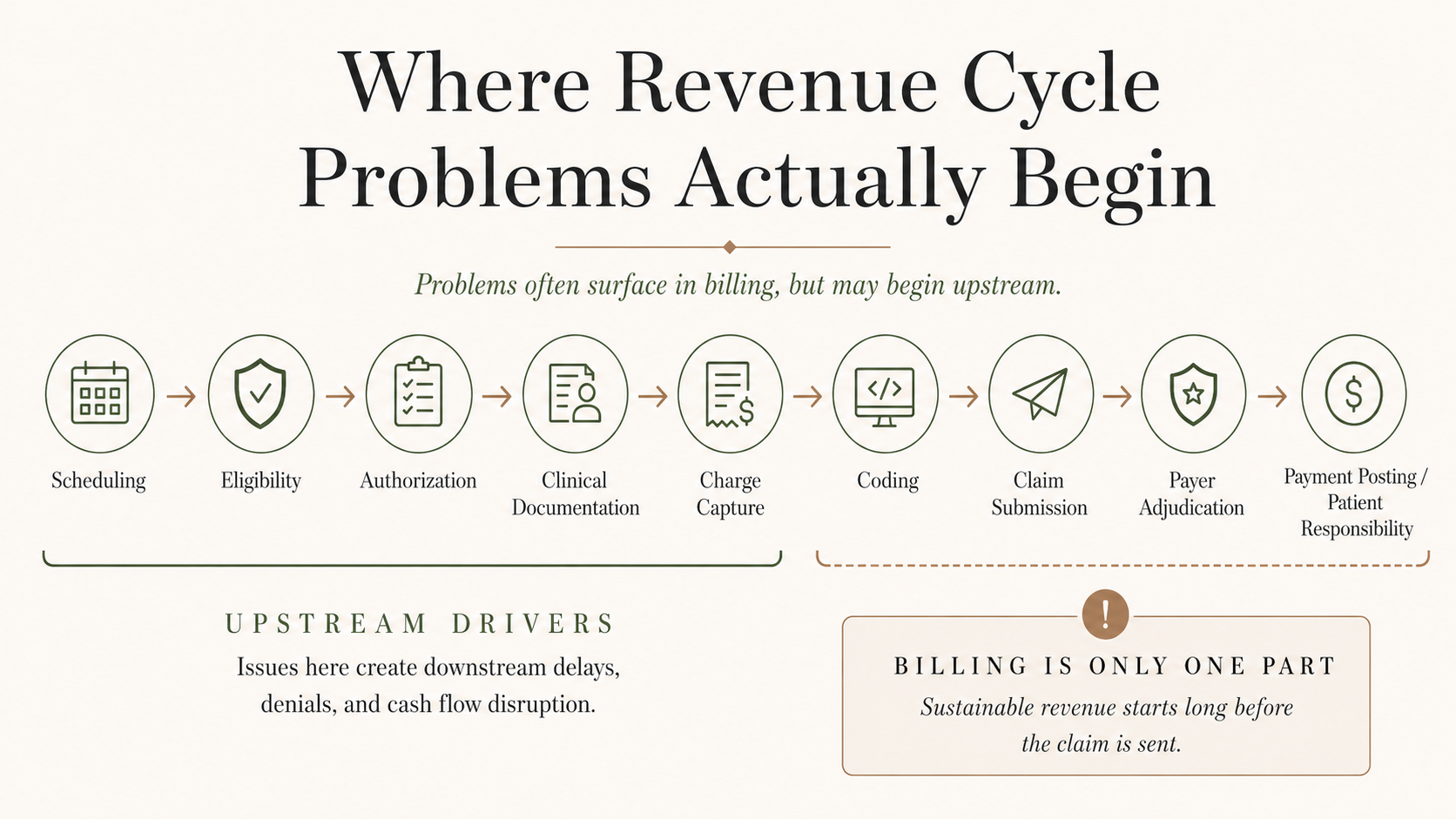
One of the most persistent problems I see in medical practices is the tendency to use “billing” and “revenue cycle” as though they mean the same thing.
They do not.
Billing is an important part of the revenue cycle, but the financial journey of a patient encounter begins much earlier. Scheduling, registration, insurance verification, authorization, clinical documentation, charge capture, coding, claim submission, payer adjudication, payment posting, patient responsibility, follow up, and contract performance all influence whether the practice is eventually paid correctly.
That distinction matters because it changes where leadership looks when something goes wrong.
If the diagnosis is automatically “billing problem,” the solution is usually directed toward the billing department. Work the accounts faster. Add another employee. Change billing companies. Increase follow up. Tighten productivity expectations.
Those changes may improve performance if billing is actually the source of the problem.
They will do very little if billing is cleaning up failures created upstream.
Consider authorization.
A service may be clinically appropriate, properly documented, coded correctly, submitted cleanly, and followed up exactly as it should be. If the payer required authorization and the practice failed to obtain it, the billing team is now attempting to recover revenue from a problem that existed before the service was even performed.
Medicare's own prior authorization guidance illustrates this principle. CMS describes prior authorization and preclaim review as ways to address coverage issues earlier in the process and potentially avoid denials and appeals later.
The operational question for the practice is therefore bigger than, “Did billing appeal the denial?”
Who identified that authorization was required? Who obtained it? How was it documented? Who confirmed that it remained valid for the date and service performed? What happens when the payer changes its requirements? Who owns the process?
If those questions do not have clear answers, adding another denial specialist may improve the cleanup effort without correcting what creates the denials.
Eligibility creates another example.
Imagine that a patient is scheduled under coverage that is no longer active, the wrong plan is entered, or the practice does not identify a deductible or patient responsibility before the visit.
The physician provides the care. The claim goes out. The payer processes it differently than expected, denies it, or assigns a larger balance to the patient.
Several weeks later, the practice has what appears to be a collection problem.
But the ability to collect that money may have been materially affected before the patient entered the exam room.
The question is not whether every eligibility issue can be prevented. They cannot. Coverage changes, payer systems are imperfect, and patients do not always understand their own benefits.
The question is whether the practice has designed a reliable process for identifying what can reasonably be known before care is delivered.
Clinical documentation is another place where operations and revenue intersect.
Physicians understandably think of documentation primarily as part of the medical record. From a reimbursement perspective, however, that documentation must also support what is ultimately reported on the claim.
CMS specifically instructs clinicians to ensure that the medical record supports the CPT, HCPCS, and ICD 10 CM codes reported for evaluation and management services.
That does not mean physicians should document for the payer instead of the patient. It means the practice cannot completely separate the clinical workflow from the financial one.
If documentation is incomplete, delayed, inconsistent, or unable to support the service reported, the billing team cannot manufacture the missing clinical record after the fact.
Again, the financial symptom arrives downstream.
The operational cause may not.
Some revenue problems are even quieter.
If a service is performed but never reaches the billing workflow, there may be no denial, no aging claim, and no work queue telling someone that money is missing.
Nothing looks broken because nothing entered the system to break.
This is why charge capture deserves more attention than it often receives.
A practice can have excellent claim submission performance and still lose revenue if services are being omitted before the claim is created. Depending on the specialty, this may involve procedures, supplies, ancillary services, injections, diagnostic services, hospital encounters, or other work that depends upon a reliable handoff from the clinical environment into the billing system.
The billing department cannot collect revenue it never knew existed.
Practices also tend to treat payment as evidence that the revenue cycle worked.
Not necessarily.
A claim may process without a denial and still be reimbursed incorrectly. A payer may apply the wrong contractual allowance, reduce a service, adjudicate something inconsistently, or create a pattern of small variances that is difficult to recognize one claim at a time.
The claim paid.
The problem is that it may not have paid correctly.
This is where revenue cycle management begins to overlap with contract management and revenue intelligence. Collections tell leadership how much money arrived. They do not automatically tell leadership whether the organization received what it was actually entitled to receive.
That is a separate question and an important one.
There is a practical reason billing becomes the default target.
Billing problems are visible.
Leaders can see accounts receivable. They can see denial queues. They can see unpaid balances. They can see lagging collections. They can ask why a claim has not been paid.
The upstream workflow that created the problem is often less visible.
Nobody may be measuring how often authorization has to be corrected after the date of service. Leadership may not know how frequently staff repair eligibility errors. Missing charges are especially difficult to see because there is no claim to appear on a report. Contractual underpayments may post quietly as completed transactions.
What gets measured becomes visible.
What becomes visible gets managed.
That can create an unfortunate situation in which the department closest to the financial symptom receives responsibility for problems it did not create and may not have the authority to correct.
Before hiring another biller, replacing the billing company, demanding more follow up, or assuming the revenue cycle team simply needs to perform better, practice leadership should ask a different set of questions.
Where did the problem actually begin? Is it isolated or recurring? Does it cluster around a particular payer, provider, service, location, or workflow? What happened before the claim reached billing? Who owns that part of the process? Does that person have the information and authority necessary to manage it? If the billing team identifies the pattern, is there a mechanism for pushing that information back upstream so the problem can actually be corrected?
These are operational questions as much as financial ones.
That is why a meaningful revenue cycle assessment cannot stop with accounts receivable reports and billing productivity. It has to follow the revenue through the practice.
From the moment the patient enters the system.
Through the clinical encounter.
Through the claim.
Through payer adjudication.
Until the correct amount of money is actually collected.
Billing is often where the problem becomes visible. It is not always where the problem began.
Independent practices operate with limited administrative capacity. They cannot afford to spend that capacity repeatedly fixing the same downstream problem.
The better opportunity is to find the point where the failure starts and fix it there.
Choose a representative sample of unpaid, denied, and paid claims. Trace each one back through scheduling, registration, documentation, charge capture, and adjudication. Include completed encounters that have not produced a claim, because an aging report alone will not show them.
For each confirmed problem, record the source, the responsible role, the correction needed, and how the team will check whether the problem recurs. Separate payer processing issues from internal workflow issues. Both deserve attention, but they require different responses.
Related reading: staffing and medical practice workflow and what to examine in a payer contract.
CMS: Prior Authorization and Pre-Claim Review Initiatives; CMS: Evaluation & Management Services.
To connect these questions with your practice’s actual workflows, explore our revenue cycle review and billing audit. If you are preparing to open a practice, our medical practice startup consulting helps build these processes before the first claim.


.webp)



-min.webp)
.svg)

.webp)